Restorative Dentistry

Inlays and Onlays

– Laboratory Ceramic Restorations
What are inlays and onlays? How are they made?

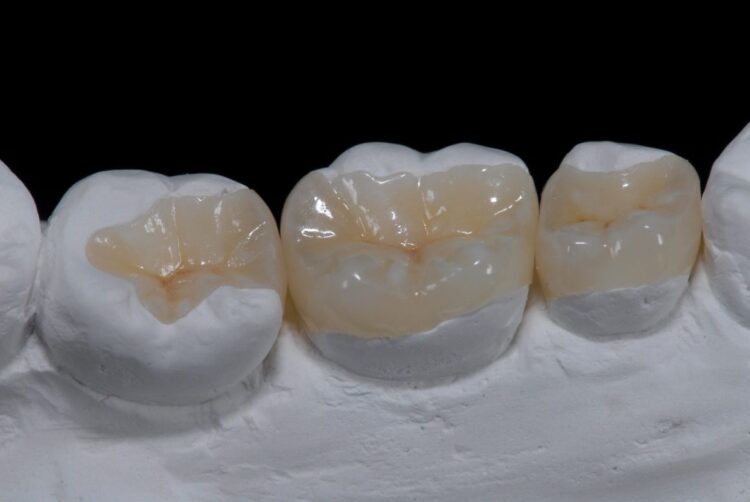
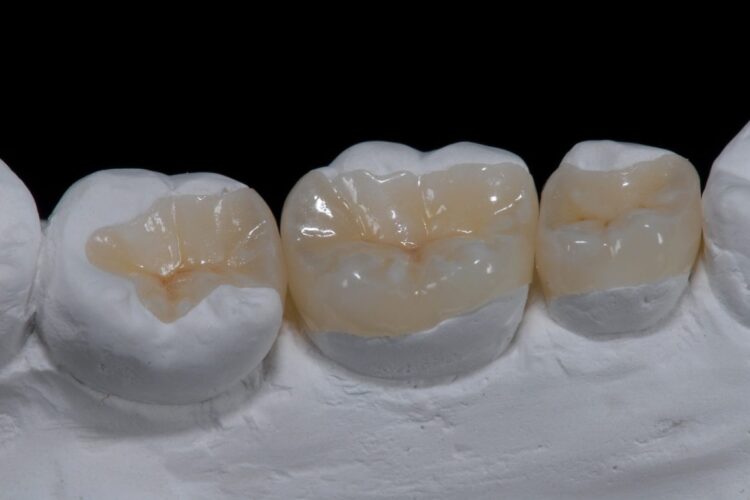
Inlays and onlays are advanced, high-precision ceramic restorations that act as customized fillings. A dental technician creates them in the lab to restore lost tooth structure with perfect fit and a natural aesthetic result.

When a tooth has extensive decay or damage that cannot be restored with a simple filling—but does not yet require a full crown—we choose an inlay or onlay.

The dentist carefully prepares the tooth to precisely receive the restoration. An impression is then taken and sent to the dental laboratory, where a durable ceramic “cap” is designed and crafted to fit exactly over the damaged area. Once returned to the clinic, the dentist permanently bonds it to the tooth, restoring both function and aesthetics.

What are the advantages?

Inlays and onlays offer significant benefits compared to other restorations:

  • Minimally invasive: Less tooth structure needs to be removed compared to crowns, preserving healthy tissue.

  • Cost-effective: More affordable than a full crown.

  • Natural aesthetic result: A wide range of shades allows perfect matching with your natural teeth for a discreet appearance.

  • Precise fit: Custom-made with high-precision digital technology.

  • Durable: Withstands strong chewing forces and wear.

  • Long-lasting: Maintains excellent condition for many years with proper oral hygiene.

  • Stable over time: Does not shrink like composite resin fillings.

  • Protects against new decay: Fits perfectly at the margins, preventing microleakage.

  • Preserves healthy tooth structure: Helps maintain the natural anatomy and overall oral health.

Will they be visible in my mouth?

No. Inlays and onlays are high-quality aesthetic restorations that blend seamlessly with your smile. The dentist selects the perfect shade so that the final result looks completely natural and is indistinguishable from your other teeth.

Why choose inlays or onlays?

Choosing inlays or onlays is a modern approach in aesthetic dentistry that combines strength, precision, and unmatched natural appearance. If you want a restoration that respects your tooth structure while providing long-term protection, ceramic inlays and onlays are an ideal solution. Consult your dentist to determine which restoration best meets your needs.

Written by Hara Kouloumpri, Dental Surgeon, Rhodes.

Contact us to schedule an appointment

RHODES SMILE DENTAL CLINIC
Hara Kouloumpri
1 Sofias Street, Rodini
85100 Rhodes, Greece
Tel: 22410 72723
Mobile 698 078 6526
Email: c.kouloumpri@gmail.com
Website: www.rhodes-smile.com

This post is also available in: Greek
Tooth Reconstruction with a Post

Tooth Reconstruction with a Post

In cases where there is significant loss of tooth structure—for example, due to trauma (tooth fracture) or decay—the tooth can be restored using a post reconstruction. For those who want to explore modern dental techniques in detail, additional resources are available from specialized dental literature.

What is post reconstruction?

This technique uses the root of the tooth as a support to “rebuild” the missing portion of the tooth.

What are the prerequisites for this technique?

  • The tooth must be root canal treated.

  • If a root canal already exists, its quality is assessed. If there are no issues, the post reconstruction can proceed immediately.

  • If the tooth has not been root canal treated, the root canal procedure is performed first, followed by the post reconstruction.

  • Additionally, the tooth, surrounding bone, and gums must be healthy, and there must be enough remaining tooth structure above the gum line to allow for a stable restoration.

What are the advantages of this method?

  • It is a cost-effective and safe restoration option compared to more expensive alternatives, such as extraction and implant placement.

  • Provides immediate aesthetic restoration in a single session.

  • Can serve as a temporary solution until the patient chooses a more permanent restoration, such as an implant or prosthetic crown.

What are the disadvantages of this method?

  • Teeth that require a post reconstruction are inherently weaker than healthy teeth. Therefore, care is needed regarding the type, hardness, and manner of food consumption.

What materials are used?

  • Fiber post: Permanently cemented into the tooth root with the same adhesive used for crowns and bridges.

  • Composite resin: The aesthetic material used to rebuild the tooth entirely, matching the natural color of the patient’s teeth.

What results can the patient expect?

A restoration that meets modern aesthetic standards while requiring some care and attention from the patient to maintain its longevity.

CASE STUDY: TOOTH RECONSTRUCTION WITH POST – ANTERIOR ZONE, YOUNG MALE CANINE

Photos of the tooth before restoration

Φωτογραφία όπου φαίνεται η συγκόλληση 2 αξόνων υαλονημάτων στο δόντι

Photo on the same day immediately after the restoration

Notice how aesthetic the result is in terms of both color and morphology.

Written by Ηara Kouloumpri, Dental Surgeon, Rhodes.

Contact us to schedule an appointment

RHODES SMILE DENTAL CLINIC
Ηara Kouloumpri
1 Sofias Street, Rodini
85100 Rhodes, Greece
Tel: 22410 72723
Mobile 698 078 6526
Email: c.kouloumpri@gmail.com
Website: www.rhodes-smile.com

This post is also available in: Greek

Share:

Bridges and Crowns

In this case, the upper jaw was restored with a zirconia bridge, designed to match the natural shade of the patient’s teeth. The chosen color respects the existing aesthetics and the natural look of the smile, ensuring a stable, functional, and fully harmonious result with the surrounding teeth.


Written by Hara Kouloumpri, Dental Surgeon, Rhodes.

Contact us to schedule an appointment

RHODES SMILE DENTAL CLINIC
Hara Kouloumpri
1 Sofias Street, Rodini
85100 Rhodes, Greece
Tel: 22410 72723
Mobile 698 078 6526
Email: c.kouloumpri@gmail.com
Website: www.rhodes-smile.com

This post is also available in: Greek

Share:

+30 22410 72723

+30 698 078 6526

Appointment

c.kouloumpri@gmail.com

Rodini, Rhodes

Sofias 1